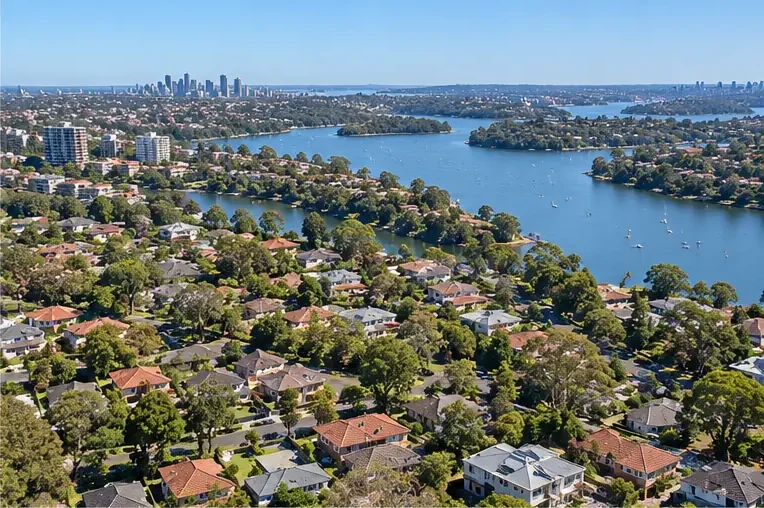
What we do across the Ryde district
-
Roof Repairs
Repairs across Ryde and Eastwood, where end-of-life terracotta and gutters overwhelmed on steep blocks cause most leaks.
Learn more -
Roof Replacement
Re-roofing inter-war bungalows across Ryde, and the low-pitch and near-flat sections on 1960s walk-ups.
Learn more -
Metal & Colorbond Roofing
Colorbond roofing across the Ryde district, including tile-to-metal conversions on low-pitch roofs.
Learn more -
Roof Restoration
Restoration for original terracotta roofs around Ryde: rebedding, repointing and recoating rather than replacing.
Learn more -
Gutter Repair & Replacement
Gutter and downpipe upgrades across Ryde, sized for the runoff a steep block actually concentrates.
Learn more -
Storm & Emergency Roof Repairs
Storm response across Ryde, Eastwood and Gladesville after heavy rain and wind.
Learn more -
Roof Inspections & Reports
Roof inspections and written reports across the Ryde district, including slate and heritage roofs at Hunters Hill.
Learn more
Local specialists you can rely on
-
Free Roof Inspection & Quote
We inspect at no cost and give you a written quote with the work itemised.
-
Licensed & Insured Contractors
Work is carried out by established, licensed and insured roofing contractors working to NSW Fair Trading requirements.
-
Hail & Storm Damage Claims
Documented inspections and reports suitable for an insurance claim after a storm.
-
Workmanship Warranty
Every job carries a written workmanship warranty.
Why water gets in up here
The Ryde district sits on a set of ridges between the Parramatta River to the south and the Lane Cove River to the east. Ryde itself tops out near 59 metres — which is why the shops at Devlin Street and Blaxland Road have been Top Ryde for generations — and Denistone East is higher again at around 80 metres. From those high points the ground falls away hard toward Glades Bay, Morrisons Bay, Buffalo Creek and the bush edges of the Field of Mars Reserve.
That fall is the local variable, and it shows up in roofs. A long run of roof pitched down a sloping block delivers its water to one or two low corners instead of spreading it around the building. Gutters and downpipes that look adequate on paper are the first thing to overtop in a real downpour, and water that gets past the roof line on a falling block has somewhere to go: along a rafter, down a wall cavity, into the ceiling.
If you have a stain, a drip or a tile on the lawn, call (02) 9100 0199. The inspection and the written quote cost nothing.

The three roofs we meet most
Inter-war and post-war terracotta
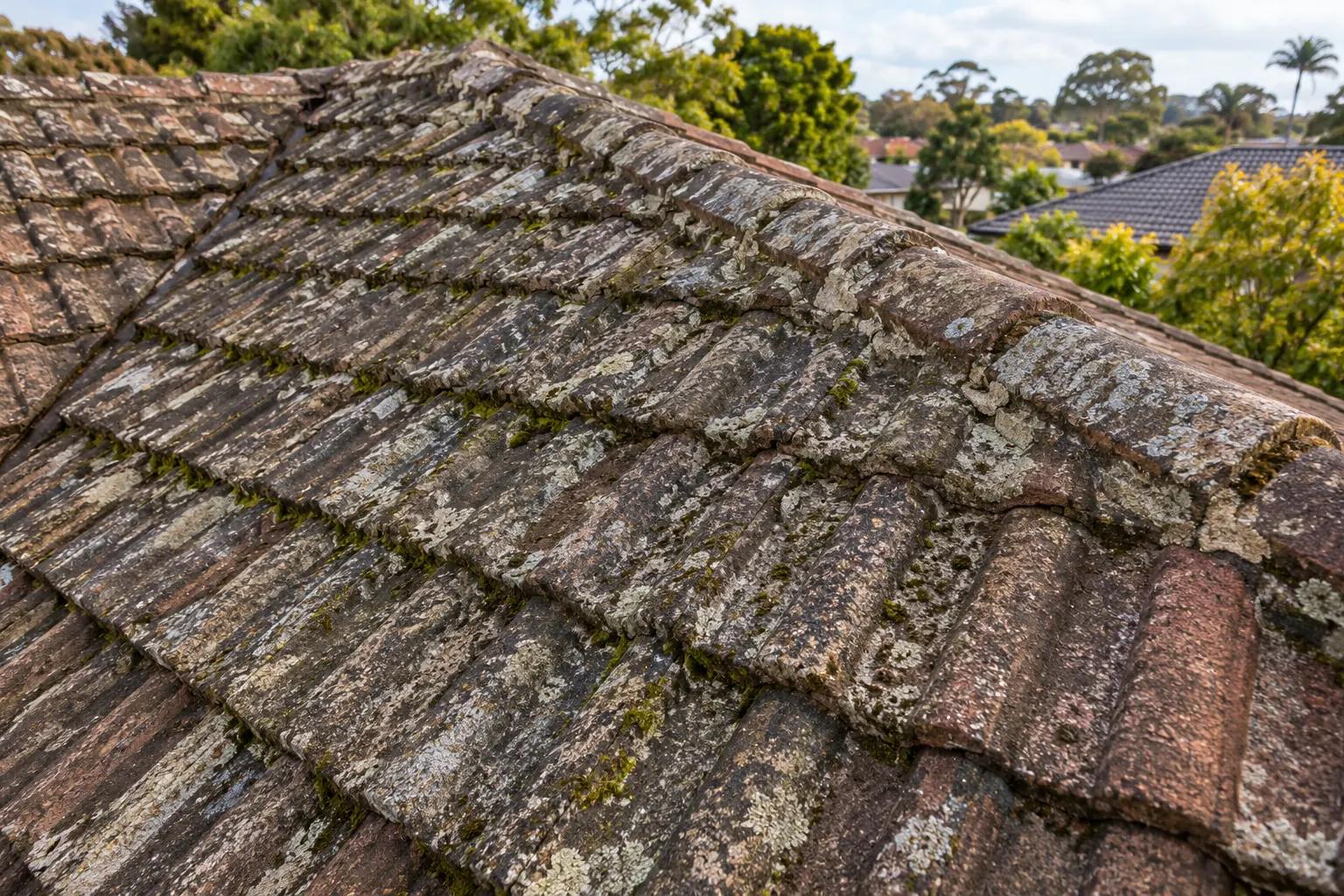
Through Ryde, West Ryde, Denistone, Denistone East and West, Eastwood and Marsfield, the core housing is brick — Federation and Californian Bungalow stock near the stations, post-war brick further out — and a lot of it still carries its original terracotta tile. Those tiles can last a very long time, but the mortar holding the ridge and hip capping does not. Bedding cracks, pointing crumbles, and water tracks under the caps instead of over them. Unglazed tile also goes porous with age and holds moss and lichen, which holds water against the tile.
Low-pitch and near-flat sections
The 1960s and 70s red-brick walk-ups across the older centres — Ryde, West Ryde, Gladesville, Meadowbank — are a different proposition. Low pitches, near-flat sections, box gutters behind parapets, and internal downpipes that have to be clear to work at all. A box gutter has no spare capacity: once the outlet chokes, the water rises until it finds the nearest join and goes inside. That is a sheet metal and drainage job, not a tile job.
Slate and heritage fabric
Then the waterfront and heritage pocket: Hunters Hill, Woolwich, Boronia Park, Henley, Huntleys Point and the Gladesville streets that sit in the Hunters Hill municipality. Sandstone houses built by the Italian stonemasons Didier Joubert brought out in the 1850s and 60s, some of them still under genuine slate, with conservation controls over what you are allowed to change. Nearer the water you also get salt in the air, which is hard on fasteners, flashings and anything galvanised.
Services across the district
- Roof repairs — leaks, broken tiles, flashings, valleys, ridge capping.
- Roof restoration — clean, rebed, repoint and recoat an ageing tile roof.
- Roof replacement — full re-roof in tile or Colorbond when repair has run out of road.
- Metal and Colorbond roofing — new metal roofs, including tile-to-metal conversions.
- Gutters and downpipes — capacity, fall, leaf guards, box gutters.
- Storm and emergency repairs — make-safe first, permanent repair second.
- Roof inspections and reports — for buyers, owners and insurance claims.
Two councils, two rulebooks
Most of the area we cover is City of Ryde. Hunters Hill, Woolwich, Boronia Park, Henley and Huntleys Point sit in the Municipality of Hunters Hill, Gladesville straddles both, and Eastwood and Melrose Park are split between Ryde and the City of Parramatta. It matters, because the two councils treat heritage differently.
The City of Ryde LEP 2014 carries a set of heritage conservation areas, expanded in late 2020 to eight, including the Darvall Estate and Chatham Road areas near Denistone and the Tyrell Street area at Gladesville. Hunters Hill is stricter again: complying development is not a pathway inside its conservation areas, and council can issue a heritage exemption letter for genuinely minor work — a slate roof replaced in slate with matching flashings and capping, for instance — rather than putting you through a full application.
Practical upshot: swapping tile for metal, or slate for anything else, is the change most likely to need consent. Fixing what is already there usually is not. We will tell you which one you are looking at before you spend anything.
What the inspection actually involves
- A walk on the roof where it is safe to do so, and a look from a ladder where it is not.
- Ridge and hip capping checked for cracked pointing and drummy bedding.
- Valleys, flashings, penetrations and any box gutters checked, since that is where leaks live.
- Gutter fall, outlet size and downpipe discharge assessed for the slope of your block.
- A look inside the ceiling space, because that is where you see the stain path, rusted valley iron and daylight.
- Photos of anything we want you to understand, then a written quote with the work itemised.
No charge, no obligation, and no pressure to decide on the spot.
What moves the price
Nobody can quote a roof honestly from a phone call. What changes the number is roof size and pitch, the material, how far the damage has already travelled, and access — a steep block with a two-storey drop at the back and no room for a scaffold costs more to work on than a single-level bungalow with a driveway beside it. Heritage requirements and matching old tile profiles move it too. We inspect, then quote, and the written quote is the price.
Call (02) 9100 0199, or send the form and we will come and look. You can also see where we work, or read how this service is put together.
Frequently asked questions
The roof looks fine from the ground, so why is my ceiling staining?
Because almost nothing fails in the middle of a tile roof. Water gets in at the joins: cracked pointing under ridge and hip capping, a rusted valley tray under the tiles, a lifted or corroded flashing where the roof meets a chimney or a wall, or a gutter backing up and pushing water behind the fascia. None of that is visible from the footpath. It usually takes a walk on the roof plus a look in the ceiling space to find it.
Do I need council approval before re-roofing a house around here?
It depends which council you are in and whether the house is listed. Across much of the City of Ryde, like-for-like re-roofing on a standard house is often handled without a development application, but the LEP also lists heritage conservation areas where it is not. In the Municipality of Hunters Hill, complying development is not available inside a conservation area, and minor heritage work can need a heritage exemption letter from council first. We check your address before quoting a material change.
Is it worth restoring ninety-year-old terracotta, or am I throwing money at it?
Sometimes it is worth it and sometimes it is not, and the honest answer comes from handling the tiles. If the body of the tile still rings and the problem is bedding, pointing, a few broken tiles and rusted valleys, restoration buys you many more years for a fraction of a re-roof. If the tiles have gone porous, delaminate at the edges or shatter when you walk them, a coating is lipstick. We say which one it is and show you why.
Who actually carries out the work if I call this number?
This site arranges the job rather than carrying it out. The work is done by established, licensed and insured roofing contractors operating to NSW Fair Trading requirements, and in NSW any residential building work over $5,000 including GST has to be done under a licence and under a written contract. You get the licensed contractor, a written itemised quote, and a workmanship warranty on the completed work.
How quickly can someone get up there after heavy rain?
Storm calls are triaged by how much water is still getting in. An active leak over a ceiling or a lifted sheet gets a make-safe visit first, which usually means tarping, securing loose material and clearing a blocked outlet so the roof can shed water again. The permanent repair is booked separately, once the roof is dry enough to work on safely and we can see the full extent. Call (02) 9100 0199 and describe what you can see and hear.
Get your free quote today
Tell us what you need and we'll get straight back to you. Prefer to talk? Call (02) 9100 0199 and speak to someone local.
Call (02) 9100 0199- Free Roof Inspection & Quote
- Licensed & Insured Contractors
- Hail & Storm Damage Claims
- Workmanship Warranty